Dreamle: One continuing voice.
Use a character brief for a recognizable role, motive and way of speaking. Dreamle publicly links a creator and advertises customization.
 Dreamle
Characters / Groups / Worlds
Every voice needs
a reason to be here.
Plan the people, the shared facts and the next decision before a story becomes a crowded conversation. Dreamle’s character, group and world routes are separate starting points.
Find a Story Worth Following
An original cast can share one setting without sharing every motive or secret.
Use a character brief for a recognizable role, motive and way of speaking. Dreamle publicly links a creator and advertises customization.
The group route is visible. Guest text does not establish cast size, speaker selection or group memory limits.
The Fantasy World route currently shows a subscription requirement. Its internal persistence rules were not verified.
An original fictional expedition / adult cast
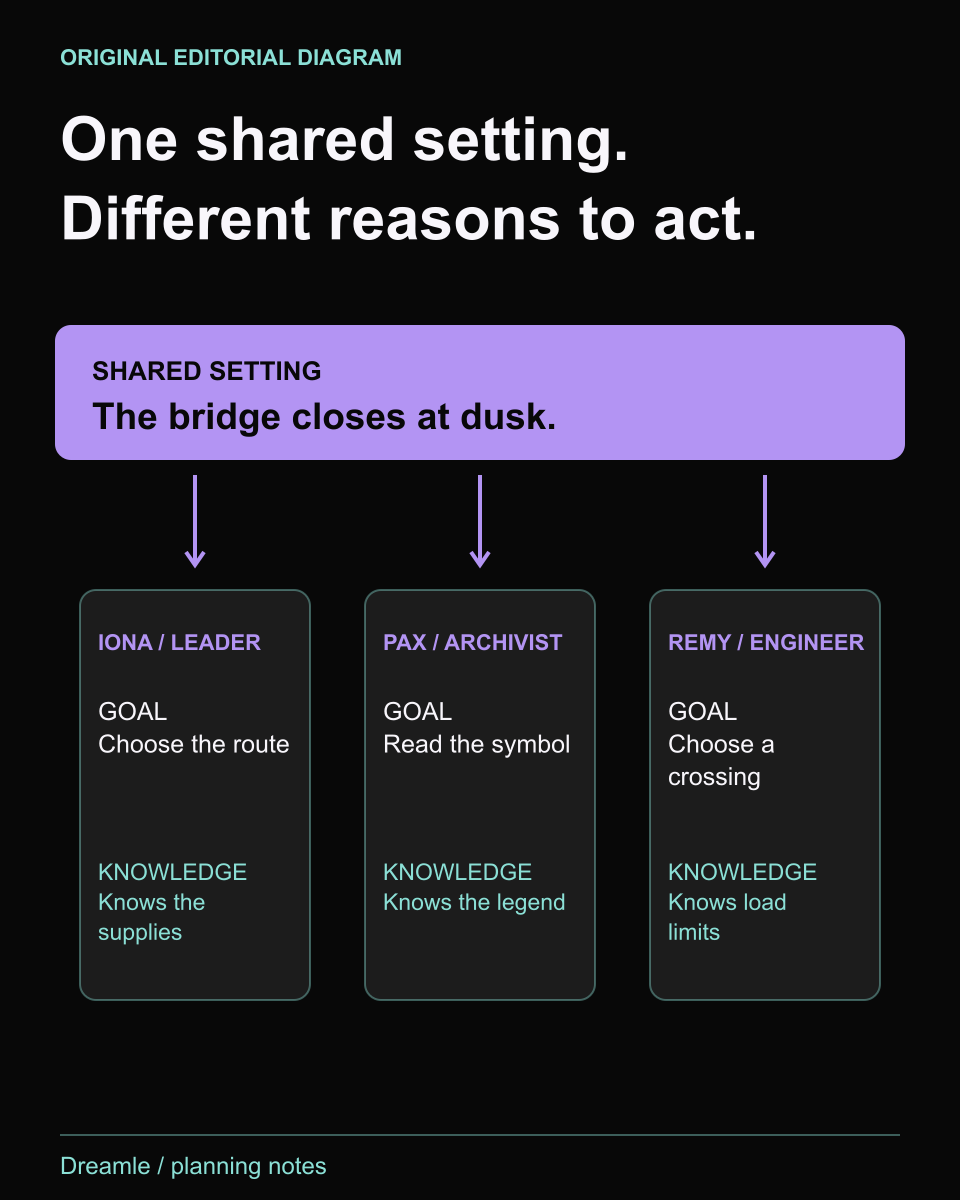
Iona chooses a route, Pax interprets the archive’s map legend, and Remy checks the crossing. Give each role the knowledge needed for that job in the worksheet below. A knowledge boundary is a narrative instruction; it is not a guarantee that a platform technically hides shared information from another character.
A local planning sheet
Edit the cast and assemble a plain-text scene sheet. This tool does not create Dreamle characters, save an account or start a chat. Use original fictional adults.
Use the sheet for the next turn
Ask Remy about the bridge’s current condition and Pax about the map symbol. Iona can then make a choice that follows from both answers. Do not mark a planned crossing as completed before the scene establishes it.
After a correction, keep only the accepted state in the working sheet. The diagram separates the roles; it does not prove shared memory or turn-order behavior in Dreamle. Those mechanisms were not exposed by the reviewed public group and world pages.
Before paying or leaving
The refund policy requires a subscription request within 24 hours of payment and says it will be denied after more than 20 LLM tokens have been used. It covers card purchases and excludes user-side technical issues.
The unit is tokens, not messages. Being inside the time window alone does not satisfy the policy.
The privacy notice describes deactivation or deletion from active databases after an account-termination request, with retained records for specified fraud, investigation and legal purposes and separate backup handling.
It supplies no matching fixed erasure deadline. Identify whether your request concerns a chat, generated media or the whole account.
The May 2024 terms list Plus, Astro and Luna recurring charges of $4.99, $11.99 and $15.99 every 30 days until cancellation, with Gems bundles described separately as one-time purchases.
These are dated agreement figures, not a checkout tested here. Read the actual selected store offer and renewal term before paying.
The privacy notice still contains unfilled server-location/contact placeholders. If storage location or deletion scope is a requirement, verify the working contact route and ask about that specific record before providing more account information.
Compare closing a session, deleting a chat and removing an account ↗Practical decisions
A Dreamle group becomes useful when its participants contribute different information to the same decision. Set the Dreamle roles and deadline clearly, then save the consequence of the discussion rather than every repeated suggestion.
A Dreamle task can need a continuing companion or several distinct contributions. Decide whether the problem requires different roles before adding them. A Dreamle group that repeats the same opinion in several voices can add length without helping you reach a useful next decision.
Give every Dreamle participant a reason to contribute information the others do not have.
For Dreamle, a group scene is easier to follow when everyone works toward the same event or decision. Define the constraint and divide responsibilities. A Dreamle planning scene about an exhibition can assign scheduling, materials and presentation without making every role responsible for everything.
Keep the Dreamle shared goal visible when the conversation starts to wander.
A Dreamle role needs a task, information it can contribute and a limit on its authority. Avoid assigning all participants the final decision. In Dreamle, one role can report options, another can expose a conflict and the reader can choose what happens next.
Use the Dreamle role tool to review whether the responsibilities are actually different.
A useful Dreamle contribution explains the fact or assumption behind a recommendation. When the scene invents a shared resource, correct that resource before choosing a plan. A Dreamle confident answer is not independent evidence that the underlying situation is true.
Keep the Dreamle fictional scenario facts distinct from verified information about a real product.
Before pausing Dreamle, save the group’s decision, the responsible role and the unresolved task. Leave rejected suggestions out unless they explain a constraint. The next Dreamle opening should begin with the consequence rather than asking all participants to repeat their introductions.
Review the Dreamle continuation note for decisions the user never actually made.
For Dreamle, the number of roles and the use of media may create different resource needs. Check the specific provider offer and purchase route. A Dreamle catalog description does not establish the final checkout total, unlimited history or every available voice feature.
Use the Dreamle source trail to verify the condition that changes your next action.
Five practical comparisons of shared lore, alternate outcomes, user-role changes, directed episodes and leaving/deleting an account.
Use Character.AI’s current Lorebook controls and a small original example to distinguish shared lore from a live group conversation.
Use an explicit branch ledger to prevent a new fictional outcome from silently replacing the original world state.
Separate returning to a fictional story from deleting conversation and account data, using each provider's actual published scope.
Distinguish a developing group exchange from the selected media, order and audience decisions of a finished episode.
Map the participant you play separately from AI characters and shared setting, using SpicyChat’s documented persona controls.
Questions for the cast
The public group route reviewed did not establish a maximum. Three roles in our worksheet are a planning choice, not a Dreamle limit.
The public route currently displays “Please Subscribe to Access this Content.” That is the observed access condition, not a complete account or pricing test.
No such behavior was verified. A shared setting, an individual character record and conversation history can be different objects.
The homepage’s linked listing could not be fetched during the review. A failed read does not prove worldwide removal, and this guide does not claim a tested installation.